
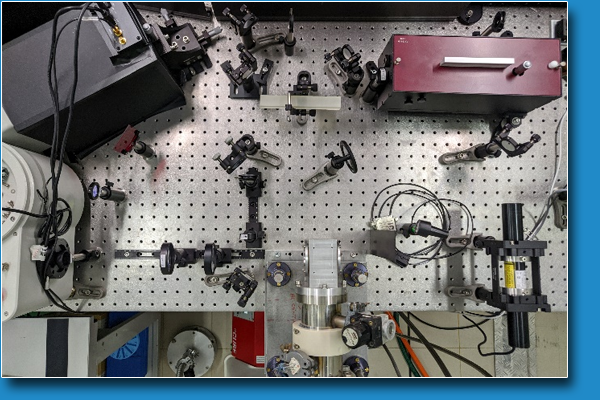
The optical setup involves excitation of the sample with a blue (405 nm) or red (633 nm) laser and collection of the photoluminescence by backscattering. The laser beam is focused onto the sample with a spot size of 100 µm, and the photoluminescence is collected by a telescope, directed into a monochromator (HORIBA Jobin Yvon – IHR320) and collected by a CCD. The temperature of the sample can be varied by a cryostat in a temperature range between 12 and 300 K.
TECHNICAL SPECIFICATIONS
- Repetition rate: CW
- Excitation energy: 405 nm, 633 nm
- Spectral range: 350-1100 nm (with 1200 gr/mm grating)
- Sample temperature: 12-300 K
AVAILABLE TECHNIQUES
- Steady-State Photoluminescence
SAMPLES
-
Solid samples. Sample holder available. Sample surface area: ideal 10 mm x 10 mm, minimum 5 mm x 5 mm, maximum 50 mm x 50 mm.
-
Liquid samples. Cuvette and rotating cell available. Solution volume: typical 300 μl, minimum 50 μl.
-
Solid samples can be studied in back-scattering up to 12K
-
Time to load the sample and start the measurement: 10 min at RT, 60-90 min at 12K
USE FOR
-
Semiconductor/ Microelectronics
-
Nanostructured materials
-
Hybrid Materials
-
Molecules and Complexes
-
Photovoltaic
-
Plasmonics
-
Photocatalysis
-
Sensors
-
Energy
 Italiano (Italia)
 English (UK)
